

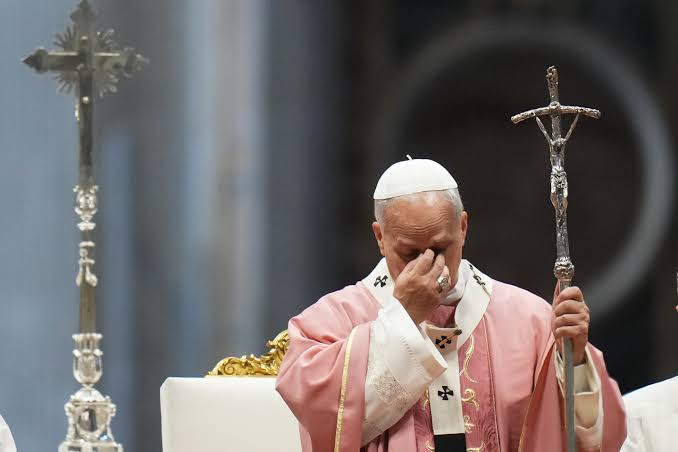
Pope Leo XIV has been diagnosed with lung cancer after undergoing surgery to remove the lower lobe of his right lung, the Vatican has announced, raising concern among Catholics worldwide as the 71-year-old pontiff begins his recovery in hospital.
According to a medical bulletin released by the Vatican, the operation was successfully performed on Tuesday at Rome’s Gemelli Hospital and lasted approximately 90 minutes. Doctors subsequently confirmed that the lung nodule discovered during preliminary examinations was cancerous, diagnosing the pontiff with lung adenocarcinoma.
“The operation was successful and there were no complications,” the Vatican said, adding that the Pope awoke normally after the procedure and returned to his room following a brief period of observation.
The Vatican reported on Wednesday morning that the pontiff had spent a peaceful night in hospital and was expected to remain there for approximately a week as he recovered.
The development has sent a wave of concern through the global Catholic community, with many faithful recalling the health struggles of his predecessor, Pope Francis, who died last year after experiencing several respiratory complications.
Despite the diagnosis, the Vatican has sought to reassure Catholics that the cancer was detected at an early stage. Pope Leo had announced on Sunday during his weekly prayers in St Peter’s Square that doctors had discovered a nodule in his lung and recommended its removal.
He had described the mass as well-contained, indicating that it had been detected before becoming more advanced.
However, further examination of the removed tissue confirmed the suspected malignancy, according to the Vatican. A Vatican source said additional tests were being conducted to determine whether the cancer had spread beyond the affected part of the lung.
The medical team removed the entire lower lobe of the Pope’s right lung to ensure the procedure was comprehensive. The Vatican also stressed that the pontiff had not exhibited symptoms of infection or other illness before the operation.
News of the diagnosis has nevertheless unsettled senior Church officials and ordinary Catholics who had hoped the relatively young Pope would enjoy a long and healthy pontificate.
Cardinal Pietro Parolin, the Vatican Secretary of State, acknowledged the shock surrounding the announcement, describing it as a sudden and unexpected development.
“Am I worried? Yes, because I certainly wasn’t expecting anything like this,” Parolin told journalists on Tuesday.
He said the cardinals had been struck by the Pope’s calmness despite the difficult circumstances and expressed confidence in his recovery.
Pope Leo’s hospital admission attracted crowds of well-wishers, some of whom gathered outside Gemelli Hospital to catch a glimpse of the pontiff. Witnesses said he waved and smiled through a car window as he arrived, before being welcomed by hospital staff.
Among those waiting outside were Catholics who said they had come to pray for his recovery and offer spiritual support during what has become a difficult moment for the Church.
“He seems calm, so we are calm too, even though illness is always unpleasant,” one Catholic, identified as Carla, said.
Another woman, Elsa, recalled being in St Peter’s Square when the Pope disclosed that he needed surgery, describing the announcement as deeply upsetting.
The diagnosis has also prompted comparisons with Pope Francis, who had part of one lung removed during his youth and later experienced repeated respiratory infections. However, the circumstances surrounding the two pontiffs’ illnesses are different, and doctors are still assessing the extent of Leo’s cancer.
Elise Ann Allen, a journalist who wrote a biography of Pope Leo, cautioned against either assuming the worst or declaring the situation resolved before doctors complete their assessments.
She said it was too early to determine the severity of the crisis, emphasising the importance of waiting for further medical information.
The diagnosis has also drawn attention to the Pope’s family, with reports indicating that his brother, Louis Prevost, has been receiving treatment for multiple myeloma, a separate form of blood cancer.
Meanwhile, prayers have intensified in Peru, where Pope Leo, formerly known as Robert Prevost, served as a missionary and later as a bishop for several years. The northern city of Chiclayo, where he spent eight years as bishop, is expected to be among the key destinations on his planned Latin American tour.
Preparations for the visit had been underway for months, with local officials anticipating that approximately 1.5 million people could travel to the city to welcome the pontiff.
The Pope’s travel schedule has reportedly been cleared until October 20 to allow him time to recover. He is also understood to be keen to proceed with the planned Latin American trip in early November, although his participation will depend on his medical condition and doctors’ advice.
For now, the immediate priority remains his recovery and the results of further tests that will establish whether the cancer has spread.
As Catholics across the world await updates, the Vatican’s assurances about the successful surgery and the early detection of the disease offer some hope, even as uncertainty remains over the pontiff’s longer-term health.