By Swift Reporter | Mr Swift
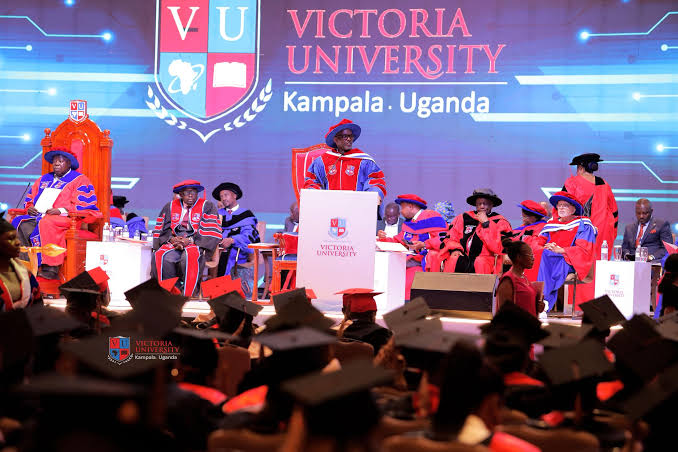
Victoria University has strengthened its standing in Uganda’s higher education sector after securing second place in the National Council for Higher Education (NCHE) Revised Institutional Ranking Report, delivering a major milestone as the institution prepares for its 10th graduation ceremony on Tuesday, October 20, 2026.
The university scored 87.4 points, placing it just behind Makerere University, which registered 88.9, and ahead of Kampala International University, which scored 85.8. The recognition places Victoria University among Uganda’s leading higher education institutions and provides a significant boost as it celebrates a decade of academic development and professional training.
The achievement comes at a defining moment for the institution, with its 10th graduation offering an opportunity to reflect on its growth, academic programmes and contribution to preparing professionals for Uganda’s evolving labour market.
According to the NCHE report, Victoria University has an enrolment of 14,113 students across 66 academic programmes, averaging 128.7 students per programme. The university was placed in the regulator’s “Leading” performance band, reflecting its performance across the indicators used to assess higher education institutions.
The ranking evaluates universities using seven dimensions: enrolment vibrancy, programme viability, graduate training strength, gender balance, participation in science, technology, engineering and mathematics (STEM), female participation in STEM, and curriculum relevance.
Enrolment vibrancy carries the highest weighting at 20 per cent, while programme viability, graduate training strength, gender balance and STEM participation each account for 15 per cent. Female participation in STEM and curriculum relevance contribute 10 per cent apiece.
Victoria University’s performance across these indicators provides insight into its student population, programme diversity and participation in disciplines increasingly associated with innovation, technological advancement and economic transformation.
Women account for 50.1 per cent of the university’s total enrolment, demonstrating a near-equal gender balance. Meanwhile, students pursuing STEM programmes constitute 52.7 per cent of the student population, with women representing 49.2 per cent of those enrolled in these disciplines.
The figures highlight the institution’s participation in science and technology-related education while underscoring the importance of expanding opportunities for women in fields that remain central to the future of work.
The second-place ranking also comes as Uganda’s higher education institutions face growing expectations to produce graduates who can respond to changing employer demands, embrace innovation and contribute to national development. In this environment, programme relevance, practical skills and the quality of graduate training remain important measures of institutional performance.
For Victoria University, the recognition adds significance to its 10th graduation ceremony, which marks another chapter in its journey as a growing private university. The milestone offers an opportunity to celebrate graduates whose qualifications and professional ambitions connect university education to workplaces, businesses and communities.
As the institution marks a decade of graduations, attention will also turn to the achievements of its alumni and their contribution across different sectors of the economy. The number of graduates expected at the ceremony and the university’s cumulative graduate output would further illustrate the scale of its contribution to Uganda’s human resource development.
The NCHE ranking provides Victoria University with a notable achievement to celebrate as it enters this milestone occasion. Sustaining the momentum will require continued investment in academic quality, research, innovation and programmes that equip students with relevant knowledge and practical competencies.
With its second-place national ranking coinciding with its 10th graduation anniversary, Victoria University has another reason to celebrate its progress while positioning itself for the next phase of growth in Uganda’s competitive higher education landscape.